Replacing your digital marketing agency is a serious decision. If done incorrectly, you can lose access to your website, marketing data, or ongoing campaigns. A proper transition ensures your business continues running smoothly without interruptions.
This tutorial explains exactly how to replace your current marketing agency safely and professionally.
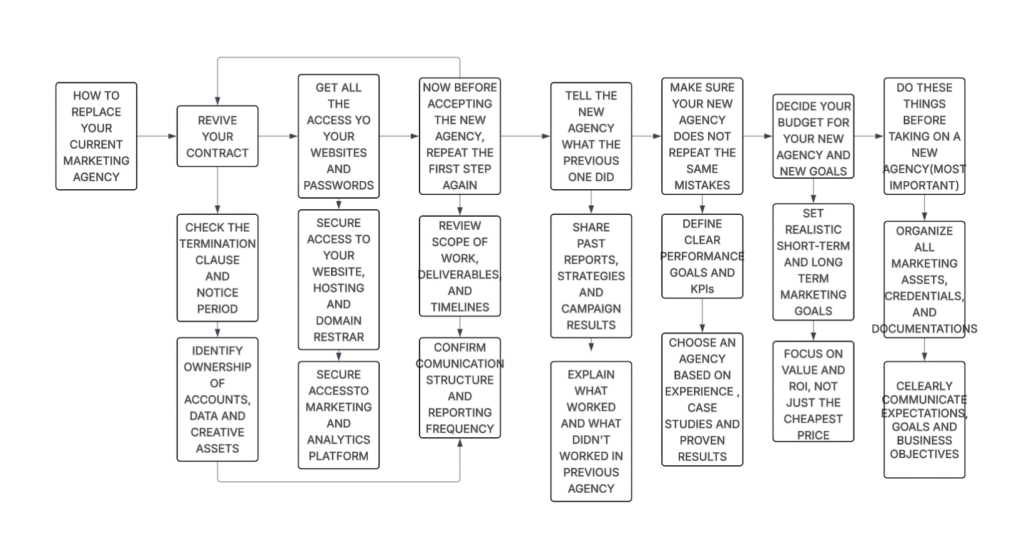
First review your contract
Before ending your relationship with your current agency, you must review the contract you signed with them. Agency contracts define important things like termination terms, ownership of assets, and responsibilities.
According to marketing industry best practices, reviewing your contract helps you understand your obligations and prevents legal or financial problems during the transition.
Your contract will also define what happens to your accounts, website, and data after termination.
Check the termination clause and notice period
Most marketing agency contracts include a termination clause. This clause explains:
- How to terminate the agreement
- How much notice you must give (for example, 30 days)
- Whether there are termination fees
You must follow this process exactly. If you terminate incorrectly, the agency may continue billing you or delay the transfer process.
Understanding your termination terms protects your business and ensures a smooth transition.
Identify ownership of accounts, data, and creative assets
You must confirm that your business owns your marketing assets. These include:
- Website
- Domain name
- Google Ads account
- Analytics accounts
- Social media accounts
- Design files and content
If the agency owns these accounts, you may lose access after termination.
Get all the access to your websites and passwords
Before switching agencies, you must secure full access to all platforms. Without access, your new agency cannot manage your marketing or maintain performance. This step ensures your business remains in control of its digital assets.
Secure access to your website, hosting, and domain registrar
Your new agency needs access to your website infrastructure to manage and improve it.
This includes access to:
- Website CMS (WordPress, Shopify, etc.)
- Hosting account
- Domain registrar
- DNS settings
- File access
Secure access to marketing and analytics platforms
You must also secure full access to your marketing tools, including:
- Google Analytics
- Google Ads
- Google Search Console
- Social media accounts
- Email marketing platforms
- CRM systems
These platforms contain critical performance data and campaign information.
Tell the new agency what the previous one did
Your new agency needs to understand your marketing history. This helps them avoid repeating ineffective strategies and improves results faster.
Providing complete information helps your new agency make informed decisions.
Share past reports, strategies, and campaign results
You should provide your new agency with:
- Marketing reports
- SEO reports
- Advertising reports
- Analytics data
- Previous strategies
This data helps the agency understand your current performance and identify improvement opportunities.
Marketing best practices recommend sharing historical data to improve strategic planning and performance.
Explain what worked and what didn’t work
You should also explain your experience with your previous agency.
Tell them:
- What strategies worked well
- What strategies failed
- What problems you faced
- What results you expected
Clear communication helps the agency avoid repeating mistakes and improve performance.
Make sure your new agency does not repeat the same mistakes
Switching agencies gives you the opportunity to improve your marketing performance. To do this successfully, you must define clear expectations and choose the right agency.
Define clear performance goals and KPIs
You must define clear marketing goals such as:
- Increasing website traffic
- Increasing leads
- Increasing sales
- Improving conversion rates
These goals are measured using KPIs (Key Performance Indicators).
Setting clear KPIs helps measure agency performance objectively.
Choose an agency based on experience, case studies, and proven results
You should evaluate agencies based on:
- Case studies
- Client testimonials
- Industry experience
- Proven results
Agencies with proven experience are more likely to deliver successful results.
Decide your budget for your new agency and new goals
Your budget determines the scope and quality of services you can receive. You must align your budget with your marketing goals.
Set realistic short-term and long-term marketing goals
Marketing takes time to produce results. Setting realistic goals helps agencies develop effective strategies.
Examples include:
- Short-term goals: improving website performance
- Long-term goals: increasing leads and revenue
Focus on value and ROI, not just the cheapest price
Choosing an agency based only on price can lead to poor results. Instead, focus on return on investment (ROI). A good agency generates more value than its cost.
Read the contract carefully before agreeing
Before signing with your new agency, carefully review their contract. This protects your business and ensures clear expectations.
Review scope of work, deliverables, and timelines
The contract should clearly define:
- Services provided
- Deliverables
- Timelines
- Responsibilities
Clear contracts prevent misunderstandings.
Confirm communication structure and reporting frequency
The contract should also define:
- Reporting frequency
- Communication methods
- Responsibilities
Clear communication improves performance and accountability.
Do these things before taking on a new agency (most important)
Proper preparation ensures a smooth and successful transition.
Organize all marketing assets, credentials, and documentation
You should gather:
- Website access
- Analytics access
- Ad account access
- Design files
- Login credentials
Clearly communicate expectations, goals, and business objectives
Clearly communicating your goals helps your agency create effective strategies and deliver better results. Successful agency partnerships depend on clear communication and defined expectations.
Replacing your marketing agency requires careful planning. By reviewing your contract, securing access to accounts, sharing previous data, defining goals, and preparing properly, you can ensure a smooth transition. Following these steps protects your business and helps your new agency deliver better results faster.
Need Help Transitioning to a New Marketing Agency?
Replacing a marketing agency can feel complicated, especially when dealing with website access, data ownership, and ongoing campaigns. If you want a smooth and secure transition, professional guidance can make the process much easier.
At Mihewa, we help businesses take full control of their digital assets and build marketing strategies that deliver measurable results.
If you are planning to replace your current marketing agency or want expert advice on improving your marketing performance, feel free to reach out.
Email: mihewa8@gmail.com
Company: Mihewa
We’ll help you move forward with clarity, transparency, and a strategy focused on real growth.